The software was approved. But is its AI still the same?
AI governance doesn't end when a product is approved. As software vendors continuously introduce new AI capabilities, financial institutions need a new approach to keeping their technology portfolios compliant and under control.
Imagine a bank's AI Governance Committee reviews a software product that includes generative AI capabilities. The team assesses the risks, evaluates the use cases, confirms compliance with internal policies, and approves the product for deployment.
Three months later, the software vendor releases an update. The product now includes an autonomous AI agent, new generative AI features, or integrations with additional large language models.
The product name hasn't changed. The vendor hasn't changed. The original approval is still documented.
But the capabilities available within the product have changed, potentially introducing new risks that were never part of the original assessment. Is the bank still using the same AI it originally approved?
This is becoming one of the most overlooked challenges in enterprise AI governance.
AI is evolving faster than approval processes
Traditionally, enterprise technology governance has focused on approving products and vendors before they enter the organization.
Once approved, a product typically remains in the technology catalog, with periodic reviews to assess security, compliance, and operational risks. Generative AI is changing that model. Software vendors are rapidly embedding AI capabilities into existing products, often without requiring customers to purchase or onboard an entirely new solution.
Consider a few examples:
- A collaboration platform introduces AI-powered meeting summaries and content generation.
- A CRM solution adds an autonomous agent capable of interacting with customer records.
- A development tool introduces AI agents that can generate and execute code.
- A productivity platform expands its AI capabilities to access additional enterprise data sources.
Each new capability can introduce different risks related to data privacy, security, model behavior, autonomy, and regulatory compliance. Yet the product may still appear as Approved in the organization's technology inventory.
The challenge is no longer simply knowing which products use AI. It is knowing which AI capabilities they provide, which have been approved, and what has changed since the last review.
Product approval is not AI feature approval
One of the fundamental changes organizations need to make is distinguishing between approving a software product and approving its individual AI capabilities.
A bank may approve a product for traditional functionality while restricting certain AI features. Even within the same product, different AI capabilities may have different approval statuses.
For example, an AI-powered document summarization feature might be approved, while an autonomous agent that accesses sensitive customer information remains under review. This creates a more complex governance model.
AI Governance Committees need visibility into:
- Which products contain AI capabilities, including AI introduced after the original product approval.
- What each AI feature actually does, rather than relying on generic vendor descriptions.
- Which capabilities have been approved, restricted, or rejected by the organization.
- When each capability was last reviewed, and whether the approval remains relevant.
- Which new AI features have appeared since the committee's previous assessment.
Without this level of visibility, organizations risk treating a product-level approval as a blanket authorization for capabilities that were never evaluated.
Monitoring thousands of products
Banks often manage thousands of software products across business units, geographies, and technology environments. An increasing number of these products are introducing AI functionality, so the scale of this problem is significant.
Expecting governance teams to manually track every vendor's product announcements, release notes, and newly introduced AI capabilities is simply not realistic.
Even maintaining an accurate inventory of AI-enabled products is difficult when information is fragmented across CMDBs, software asset management platforms, enterprise architecture repositories, and spreadsheets.
The problem becomes even more challenging when governance teams must identify not only what AI capabilities exist today, but what has changed since the last approval.
An AI inventory that was accurate yesterday may already be incomplete today.
This is why AI governance cannot rely exclusively on periodic reviews or manually maintained questionnaires.
From one-time approval to continuous AI governance
The next generation of AI governance needs to move from a static approval process to a continuous monitoring model.
Rather than asking only whether a product was approved, organizations should continuously evaluate whether the product's current AI capabilities remain aligned with what was authorized.
This requires three fundamental capabilities:
1. Continuous AI feature discovery
Organizations need an up-to-date understanding of which AI capabilities are available across their technology portfolios, including new features introduced by existing vendors.
2. Feature-level approval tracking
Each AI capability should be associated with its own governance status, review date, and relevant approval decisions. Approving one feature should not automatically imply approval of every AI capability within the same product.
3. Automated change detection and prioritization
When a vendor introduces new AI functionality, governance teams should be able to identify the change, understand its potential implications, and prioritize the products that require renewed attention.
4. Risk-based review and response
Not every new AI feature warrants a full reassessment. Organizations need a way to distinguish routine updates from material changes that could affect data access, model behavior, autonomy, or regulatory obligations, and route those changes to the appropriate teams for review.
This approach allows AI Governance Committees to focus on what actually requires a decision, rather than repeatedly reviewing products where nothing material has changed.
Importantly, detecting a new capability does not necessarily mean it has been enabled or used within the bank. Governance teams still need to validate deployment and usage. But they cannot make that assessment if they are unaware that the capability exists.
How Entrio helps close the gap
At Entrio, we believe effective AI governance starts with accurate, continuously updated technology intelligence.
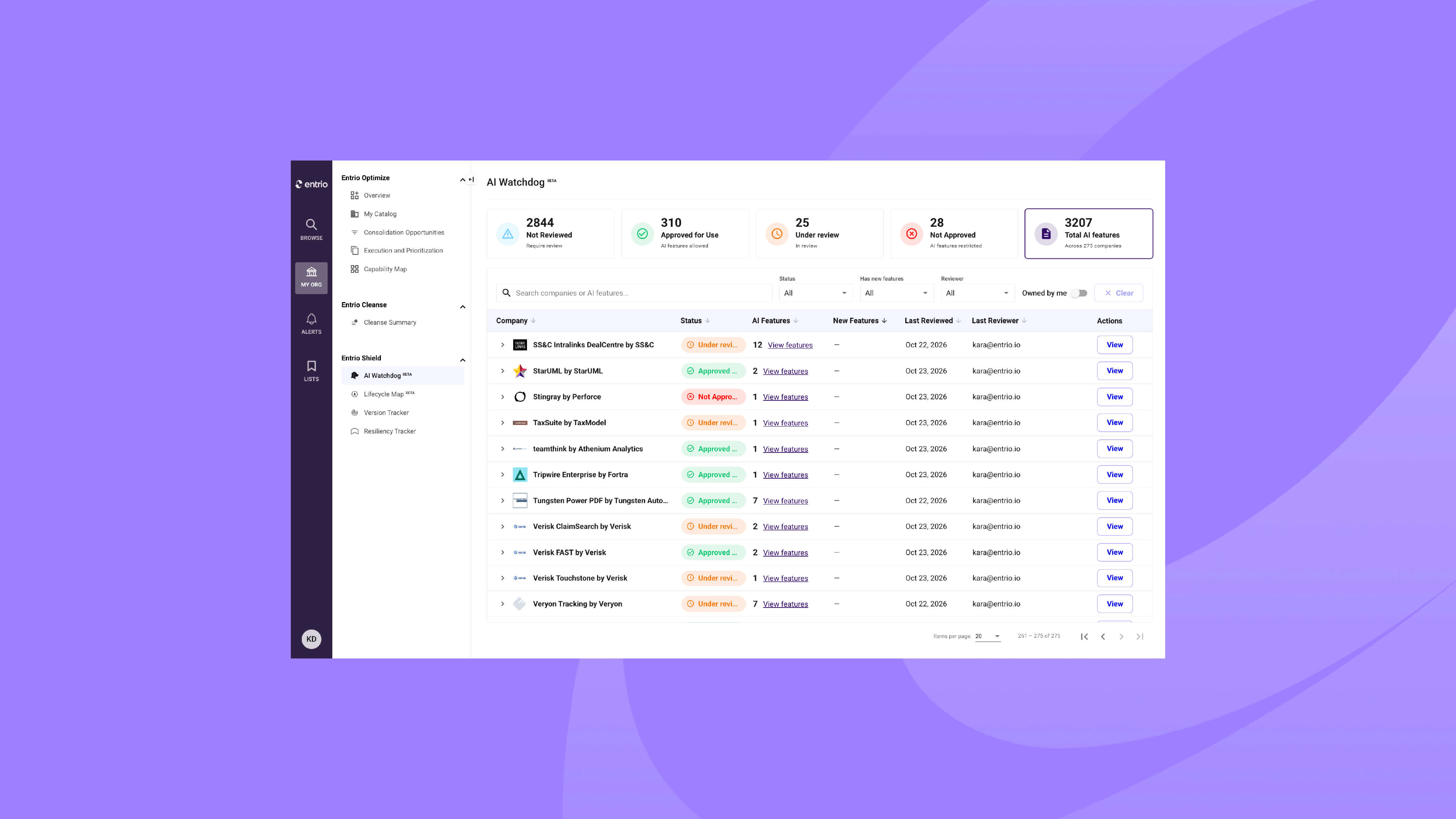
Through our AI monitoring capabilities, we help financial institutions identify AI-enabled products across their technology portfolios, understand the AI features they provide, and track governance decisions at the individual feature level.
By continuously monitoring newly introduced AI capabilities, Entrio helps highlight products that may require additional review, even when those products have already been approved.
This gives AI Governance Committees, enterprise architects, and risk teams a more actionable view of their AI landscape, without relying entirely on manual vendor research.
The goal is not to replace the governance committee or automate its approval decisions. It is to provide the intelligence needed to make those decisions efficiently and confidently.
Don't let yesterday's approval govern today's AI
AI governance is no longer just about deciding which AI products an organization can adopt. It's about maintaining visibility and control over AI capabilities that continue to evolve long after the original approval.
As vendors introduce new models, agents, and AI-powered features at an accelerating pace, the gap between what was originally approved and what is currently available will only grow.
Financial institutions need to move beyond static inventories and one-time approvals toward continuous, feature-level AI governance. Because approving AI is a decision made at a point in time. Governing it is an ongoing responsibility.